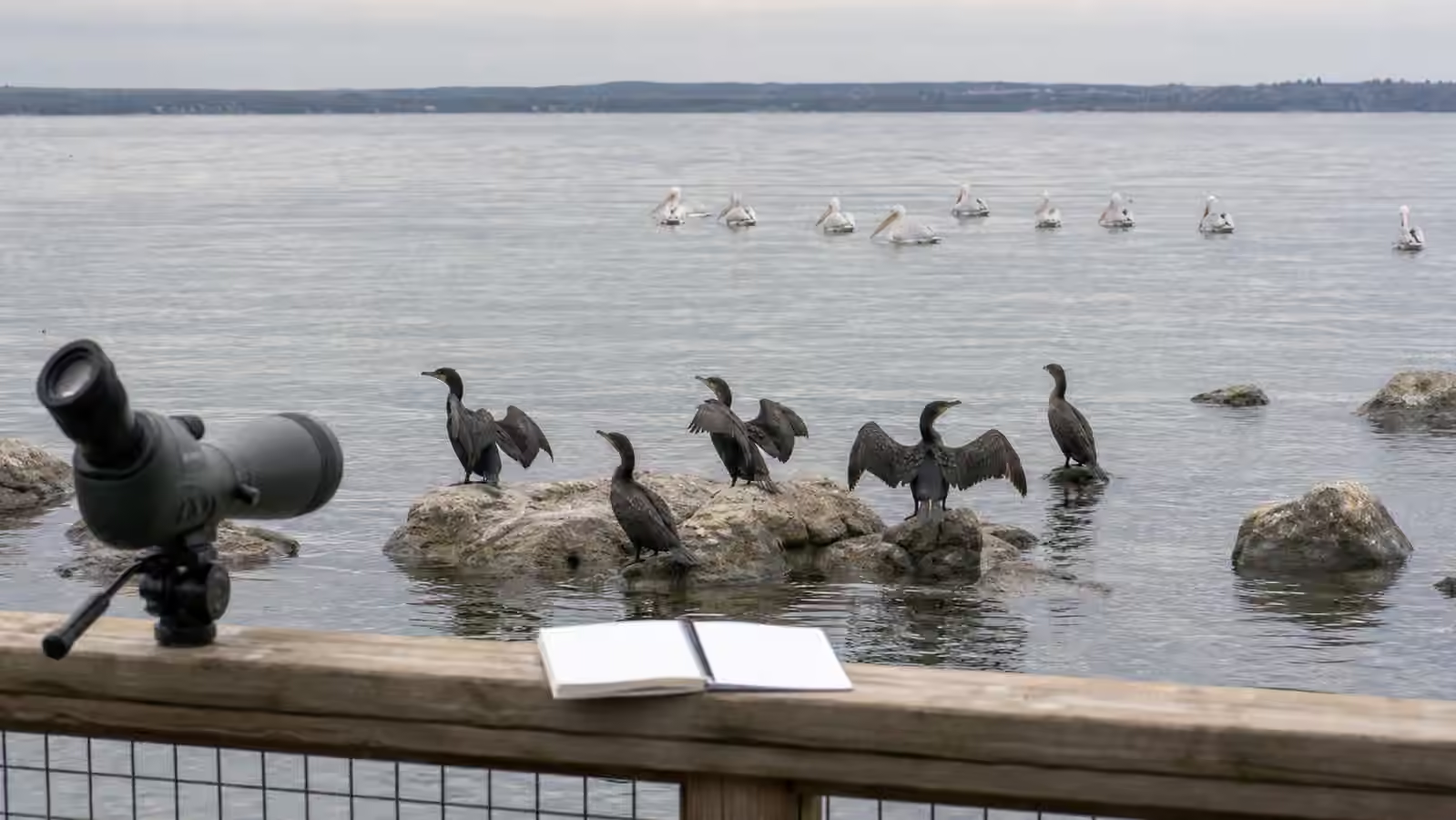
Big-water birds can look simple from far away. A dark bird stands on a rock with its wings open. A line of pale birds rests beyond the buoy line. A long-necked shape dives and surfaces somewhere else. A flock crosses the bay in slow wingbeats, then becomes too distant to name. Beginners often try to force these views into quick labels, but cormorants, pelicans, and similar waterbirds are better approached through posture, behavior, and distance.
This guide sits between Water’s Edge Birding , Loons, Grebes, and Diving Waterbirds for Beginners , and Seawatching and Big-Water Birding . Those guides teach you to read water, diving, and distance. Cormorants and pelicans add two especially visible lessons: how birds use open water in groups, and how much a silhouette can tell you before color or fine marks appear.
Start With Where The Bird Sits
Many cormorant-like birds sit low in the water, with a long neck and a body that can almost disappear behind small waves. When perched, they may stand upright on rocks, posts, pilings, buoys, sandbars, dead trees, or harbor structures. Wing-spreading is a familiar behavior, but it should not be treated as the only clue. Posture, neck angle, bill shape, tail length, and the way the bird balances on a perch all matter.
Pelican-like birds often read differently at a distance. They can look larger, broader, and heavier, with a long bill and a body that sits more like a floating vessel than a thin-necked diver. Some rest in groups. Some move in lines. Some feed by plunging, dipping, or working with other birds, depending on species and region. The exact birds vary by place, so the beginner task is not to memorize another coast’s checklist. It is to notice how size, posture, and feeding method separate one kind of big-water bird from another.
Habitat gives the first frame. A rocky lake edge, tidal inlet, fishing pier, reservoir, river mouth, island roost, or sheltered bay may each support different behavior. Before naming a bird, ask what the place is offering. Is there a perch for drying? Is there open water for group feeding? Is there a current line, fish concentration, sandbar, or safe roost?
Wing-Spreading Is Behavior, Not A Pose
The classic cormorant posture, standing with wings open, can make the bird look almost theatrical. It is useful to notice, but it is better to treat it as behavior rather than a static symbol. Which birds are spreading their wings? Are they facing sun or wind? Are they alone, spaced along rocks, or crowded on a structure? Are other birds preening, sleeping, diving, or arriving from the water?
That context keeps the observation alive. A perched bird with wings open may have just left the water. Another may be jostling for space. Another may close its wings and drop back to fish. If you watch long enough, the rock becomes a small schedule of drying, resting, arguing, and returning to the water.
Reading Bird Behavior for Beginners encourages this kind of attention. Behavior is not extra decoration after the identification. It is evidence. It also protects you from turning every dark perched bird into the same mental picture.
Diving Birds Do Not Surface Where You Expect
Cormorants can frustrate beginners because a bird that dives in one place may surface far away. If you keep your binoculars locked on the spot where it vanished, you may miss the bird rising at a different angle. Instead, widen your attention. Watch the direction of the dive, the time underwater, nearby ripples, and whether several birds are working the same area.
Group fishing can be especially useful. Birds may spread in a loose line, push prey toward shallower water, surface in sequence, or move along a channel. You do not need to identify every individual to learn from the pattern. The group is using the water as a feeding field, and your job is to read the field.
This differs from watching loons and grebes, even though all may dive. Loons, Grebes, and Diving Waterbirds for Beginners focuses on birds that often sit low, vanish, and reappear with fine differences in shape. Cormorant-like birds add stronger perching, group roosting, and wing-spreading cues. Comparing those habits helps you avoid guessing from one distant dark shape.
Flight Lines Reveal Size And Purpose
Big-water birds often commute along predictable lines. Cormorants may fly low over water with steady wingbeats, sometimes in loose lines or small groups. Pelican-like birds may travel with deep wingbeats and glides, sometimes forming lines that rise and fall together. At a distance, these flight styles may be more useful than plumage.
The lesson connects with Flight Style and Wingbeats . Notice whether the bird flies low or high, whether the neck is stretched, whether the wings look narrow or broad, whether the group is organized, and whether the birds are traveling or feeding. A flock moving steadily across a bay tells a different story from birds circling and dropping over a fish concentration.
Use landmarks when watching flight. A line of birds passing the headland, crossing the channel, or moving between two islands gives you a record that can be checked later. “Large birds flew left” is vague. “Seven large pale birds crossed the mouth of the bay from the breakwater toward the far marsh, alternating flaps and glides” is much more useful.
Distance Calls For Honest Tools
A spotting scope can make cormorants, pelicans, gulls, loons, grebes, ducks, and distant shorebirds more understandable, but it does not erase distance. Heat shimmer, glare, rain, haze, waves, and backlight can all remove detail. Begin with binoculars or naked-eye shape, then use the scope for questions. Is the bird’s bill heavy? Are the wings held open? Is the group on rocks or floating? Are birds diving, sleeping, preening, or flying?
Spotting Scope Fieldcraft matters here because big-water birding can tempt people to chase access. A scope should help you accept distance, not pressure a roost. Birds resting on rocks, pilings, sandbars, or islands are often using limited safe space. If approaching by foot, boat, or shoreline path changes their posture or sends them into the water, the view has cost too much.
Photography follows the same rule. A distant image can support a note, especially when it preserves group size, posture, or flight shape. It should not become a reason to crowd a roost or block other people using an overlook.
Write Notes That Preserve The Scene
Big-water notes need more than a name. Include the water body, distance, light, group size, posture, and behavior. A useful note might say that dark long-necked birds were perched on low rocks with several wing-spreading while larger pale birds floated in a loose line farther offshore. Another might say that a group of dark divers worked along a current line, diving repeatedly and surfacing farther downwind.
Those notes are valuable even if one bird remains unidentified. Honest uncertainty is part of waterbirding. A backlit bird crossing the bay may be identifiable only to group. A distant white bird may need a scope view you did not have. Birding Checklists and Local Records treats that honesty as a strength. The record should show what the view supported, not what you wished it supported.
Over time, the large water scene becomes less blank. You learn which rocks hold drying birds, which wind direction brings birds closer, which channels attract diving, and which distant lines are only buoys until they move. The names improve because the place has become readable.
Cormorants and pelicans are good teachers because they are visible without being simple. They ask you to watch size, posture, groups, water, and restraint. The better you read those things, the less often big water turns every bird into a distant guess.